
For fifteen years, enterprises built something remarkable: a library of their business. Every fact was catalogued, shelved, and indexed. If you knew what you were looking for, you could find it. Quarterly revenue, churn by region, pipeline by stage: all there, neatly labelled.
It was a genuine achievement. It is also not what AI needs.
Agents Don't Look Things Up. They Find Their Way.
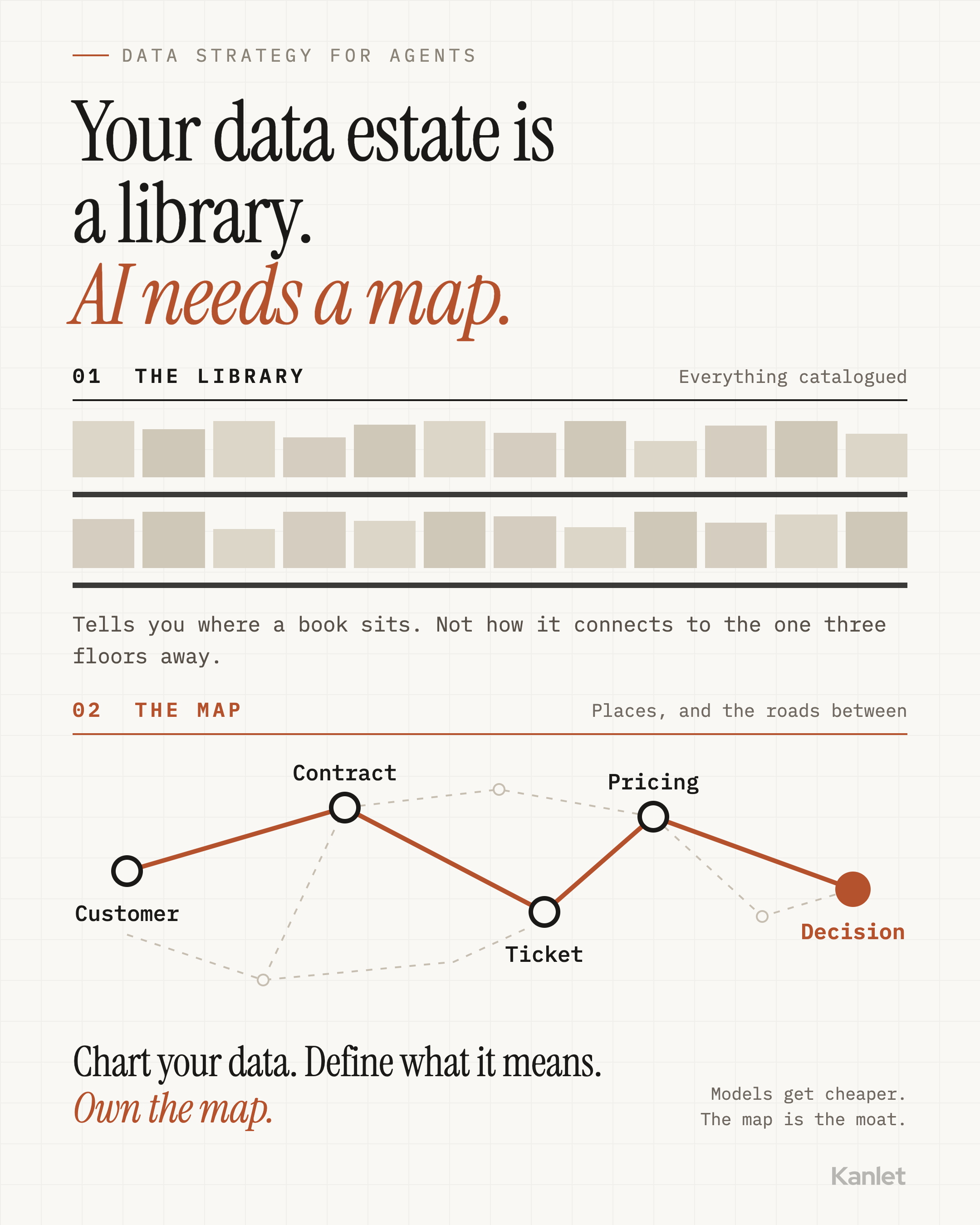
A person walks into a library with a question and leaves with a book. An agent works differently. It starts at a customer, moves to a contract, crosses to a support ticket, detours through a pricing policy, and arrives at a decision. It isn't retrieving. It's navigating.
It follows chains of meaning across products, customers, processes and policies crossing the boundaries the data systems kept apart. And a library cannot hold a chain. The moment intelligence needs relationships, the library model breaks.
A library can tell you where a book sits. It can't tell you how that book connects to the one three floors away. For that, you need a map: places, and the roads between them.
The age of AI is not library-based. It is map-shaped.
A Brilliant Driver with No Map Still Gets Lost.
Every company now has access to extraordinary models. That advantage lasts about a quarter, until a competitor licenses the same one. The model is the driver: fast, capable, confident.
"Drop that driver into a city with no map, conflicting street signs, and half the roads unmarked, and it will drive efficiently to the wrong address. The failure won't look like a failure. It will look like a well-reasoned answer."
The problem was never the driver. It's the terrain we never charted, the integration work we kept pushing to next year. AI did not create it. AI just made it impossible to keep ignoring.
The Map Is the Asset.
Every road you draw is something your business has learned: which customers expand, which risks cluster together, why a renewal slipped. Over time those roads add up to a working model of how your company actually operates.
That model is your territory. Guard it accordingly. Models will keep improving and keep getting cheaper, and you should happily swap them as they do. The map is different. It is the accumulated conceptual knowledge that forms the ontological core of your organisation. It is the most valuable asset you will build this decade. So build it the right way.
Chart your data
Surface the entities, objects, and relationships that actually matter to your business.
Define what it means
Anchor business rules, metrics, and taxonomy into a deterministic semantic layer.
Own the map
Models get cheaper. The map is your organizational moat. Guard and evolve it continuously.
The library served us well. Now it's time to draw the roads.