Agents pull from the wrong tables
Lacking semantic grounding, agents match on field names, not business meaning.
Data is everywhere but AI need context to make sense of it.
Kanlet turns your data and institutional knowledge into a unified semantic context layer
- so AI understands your business the way your best employees do.
Every enterprise AI story starts the same way: a promising pilot, a successful demo, a wave of excitement. Then progress stalls.
Not because the models aren't smart enough. Because they don't understand the business they are operating in. They don't know your definitions, your processes, your exceptions, your relationships, or the knowledge your teams have accumulated over years of experience.
AI without context is forced to guess. That's why so many AI initiatives struggle to move from prototype to production.
The missing layer isn't another model. It's a shared understanding of how the business works.
Without shared understanding of metrics, definitions, relationships, and institutional knowledge, AI agents are forced to operate in the dark.
60%
of Agentic analytics projects relying solely on MCP
will fail by 2028 due to the lack of a consistent
semantic layer.
Gartner · FEB 2026
Only 18%
of Chief Data and Analytics Officers are confident
they can build a semantic layer, despite it being a
top priority.
Gartner · MAR 2026
By 2027, organizations that prioritize semantics in AI-ready data will increase their agentic AI accuracy by up to 80% and reduce costs by up to 60%.
Gartner · May 2026
Lacking semantic grounding, agents match on field names, not business meaning.
When definitions conflict, AI quietly chooses one and never tells you it did.
Every team calculates key metrics its own way, so AI reports contradict each other.
PII tag changes don’t propagate, exposing downstream assets un-governed.
Schemas shift faster than anyone can document, leaving AI to hallucinate.
By defining business logic, metric definitions, and organizational knowledge once in a unified semantic model, Kanlet guarantees consistent, trustworthy answers across all AI workflows.
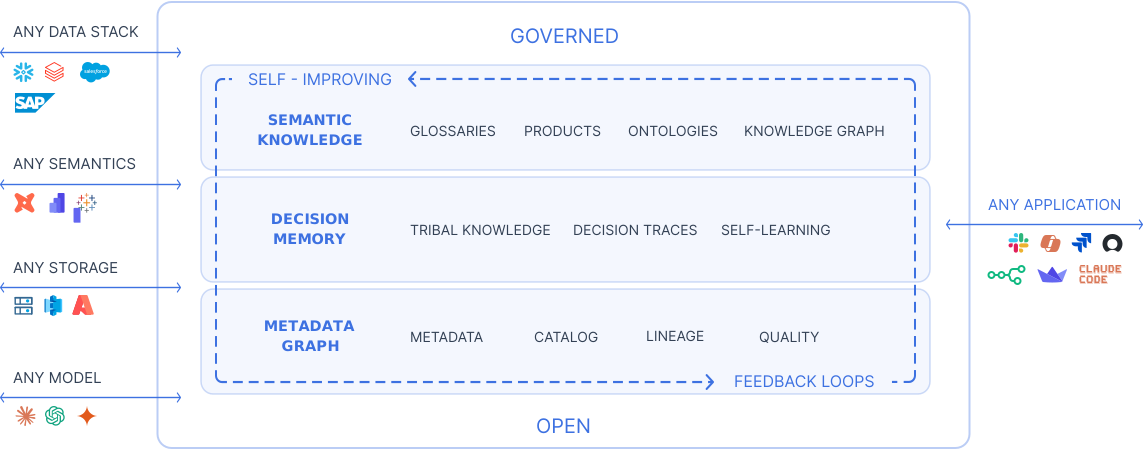
What is happening in the enterprise?data, metadata, entities, relationships, business definitions.
What is the business meaning and context?institutional knowledge, prior decisions, policies, business rules, exceptions.
How do actions are performed?available tools, APIs, workflows, permissions, dependencies, procedures.
How to execute decisions through enterprise systems?CRM, ERP, ticketing, communication, analytics, etc.
An agent without shared context picks the first plausible table and answers with total confidence, even when it's wrong. Ground it in a semantic layer and it resolves the right table, join, and definition first so it either gets the number right, or says it doesn't know, instead of guessing convincingly.
Without shared context, every agent burns tokens rediscovering your schema dumping tables into the prompt, guessing at joins, retrying wrong queries. Resolving that once, upstream, cuts agent unnecessary token usage and gets you to an answer faster.
Ask your BI copilot and support bot, or internal agent the same question today and you can get different numbers, each confidently wrong in its own way. A shared context layer means every agent reasons from the same definitions, so the answer doesn't change depending on who's asking.
When an auditor, regulator, or stakeholder asks “Why is this number correct?” confidence isn't enough, you need evidence. A semantic context layer connects every definition, metric, and decision to its source, owner, approval, and history. So answers aren't just plausible; they are grounded in documented, accountable context that can be traced and explained.
Consume governed context through programmatic interfaces. Execute tasks with clearer semantics, policy awareness, and traceable reasoning.
Define and manage semantic context centrally. Treat it as a reusable that can be tested, versioned, governed, and delivered across all AI agents.
Discover reliable business data without waiting on technical teams. Move from questions to insights and decisions faster.
Accounts and transactions resolve to one entity, informed by how your team has resolved false positives before so alerts fire on what's actually connected.
Claims and billing connect to a unified policyholder record, ensuring every payout is tied to a verified relationship.
Portfolio and risk data connect in one view, giving you an accurate picture of what you hold now.
EHR and claims join into one patient record, carrying forward every prior authorization exception your team has already ruled on.
Fleet and freight resolve to one operational view, carrying the exception-handling your team has already worked out so rerouting reflects real judgment, not just live GPS.
Billing and network state unify with the judgment calls your support team has made before so the agent doesn't just have data, it has precedent.
Bring a production use case. We will build the semantic context layer in
a proof of value, on your data, owned by you.