
Everyone is talking about knowledge graphs. Few are talking about where to start.
Knowledge graphs are finding their way into almost every enterprise AI conversation. Consulting firms are recommending them. Technology vendors are positioning them as essential infrastructure. Executives are being told that autonomous AI agents, powered by knowledge graphs, are the next major step in enterprise transformation.
None of that is necessarily wrong.
The problem is that the conversation often begins at the end.
The Premature Jump to Knowledge Graphs
Very little attention is given to what needs to happen before an organization can realistically put autonomous agents on top of a knowledge graph.
You cannot simply move from fragmented data, disconnected applications, inconsistent definitions, and incomplete metadata to AI agents that can reliably reason and make decisions.
There is foundational work in between, and it is often overlooked. Too many organizations are being encouraged to design ontologies and build graphs before establishing the underlying meaning those structures are supposed to represent.
The Progression Through Layers of Meaning
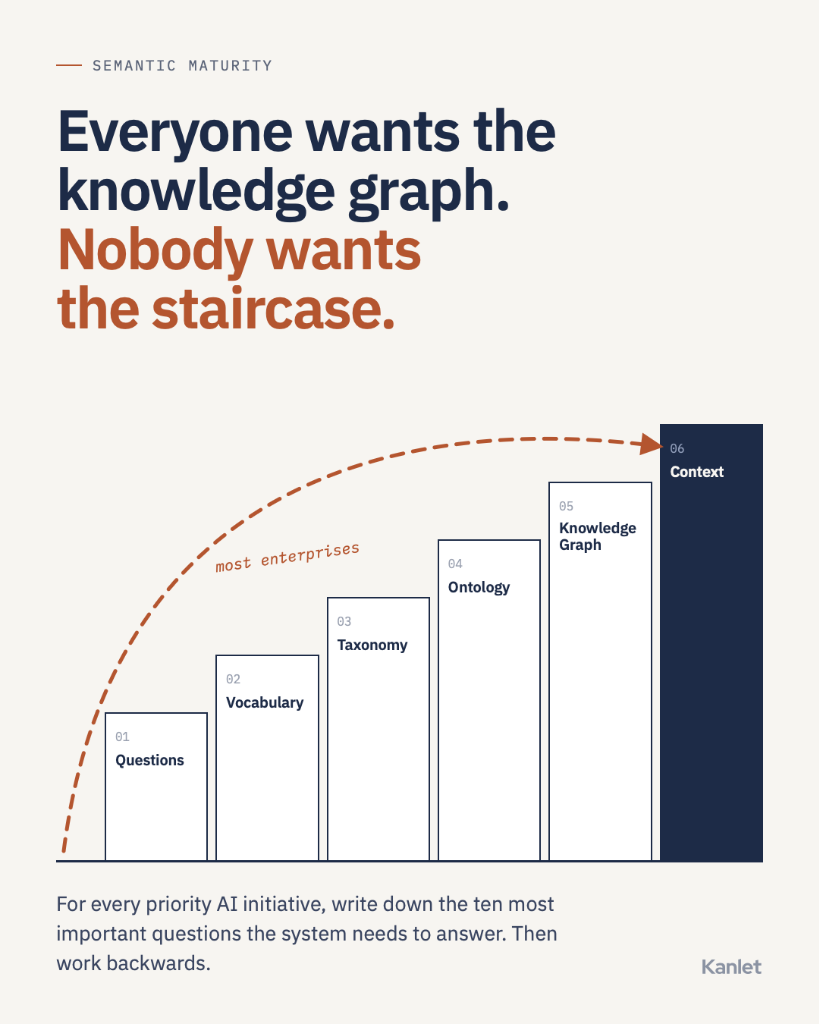
Semantic maturity is not a single technology implementation. It is a progression through layers of meaning:
Shared Vocabulary
It starts with a shared vocabulary. Before systems or AI agents can reason consistently, the organization needs agreement on what things mean and what they are called. Is this a customer, client, account, or member?
Taxonomy
The next layer is taxonomy. Vocabulary names concepts. Taxonomy organizes them into meaningful categories and hierarchies.
Unified Data Model
Then comes the unified data model. For a specific use case, what entities matter? How do they relate? And how do those relationships work in your organization?
Ontology
Only then does ontology become truly meaningful. Ontology introduces formal definitions, relationships, constraints, and rules that allow systems to interpret and potentially reason over information.
Knowledge Graph
Then comes the knowledge graph, connecting those concepts and rules to real enterprise data and knowledge sources with lineage, governance, and traceability.
Semantic Context Layer
A semantic context layer can bring this understanding together and make it available to AI, applications, analytics, and people.
Preserving Shared Meaning Across Systems
Most enterprises already have plenty of data.
What they lack is shared meaning and mechanisms to preserve that meaning as information moves across systems, teams, applications, and AI agents.
"That is why reports disagree, reconciliation becomes manual, and AI answers can sound convincing until an important business decision depends on them."
Where Should You Start?
Start with the use cases.
For every priority AI initiative, write down the ten most important questions the system needs to answer. Then work backwards.
It sounds basic. It isn't.
Because reliable AI starts with understanding what your business actually means.